

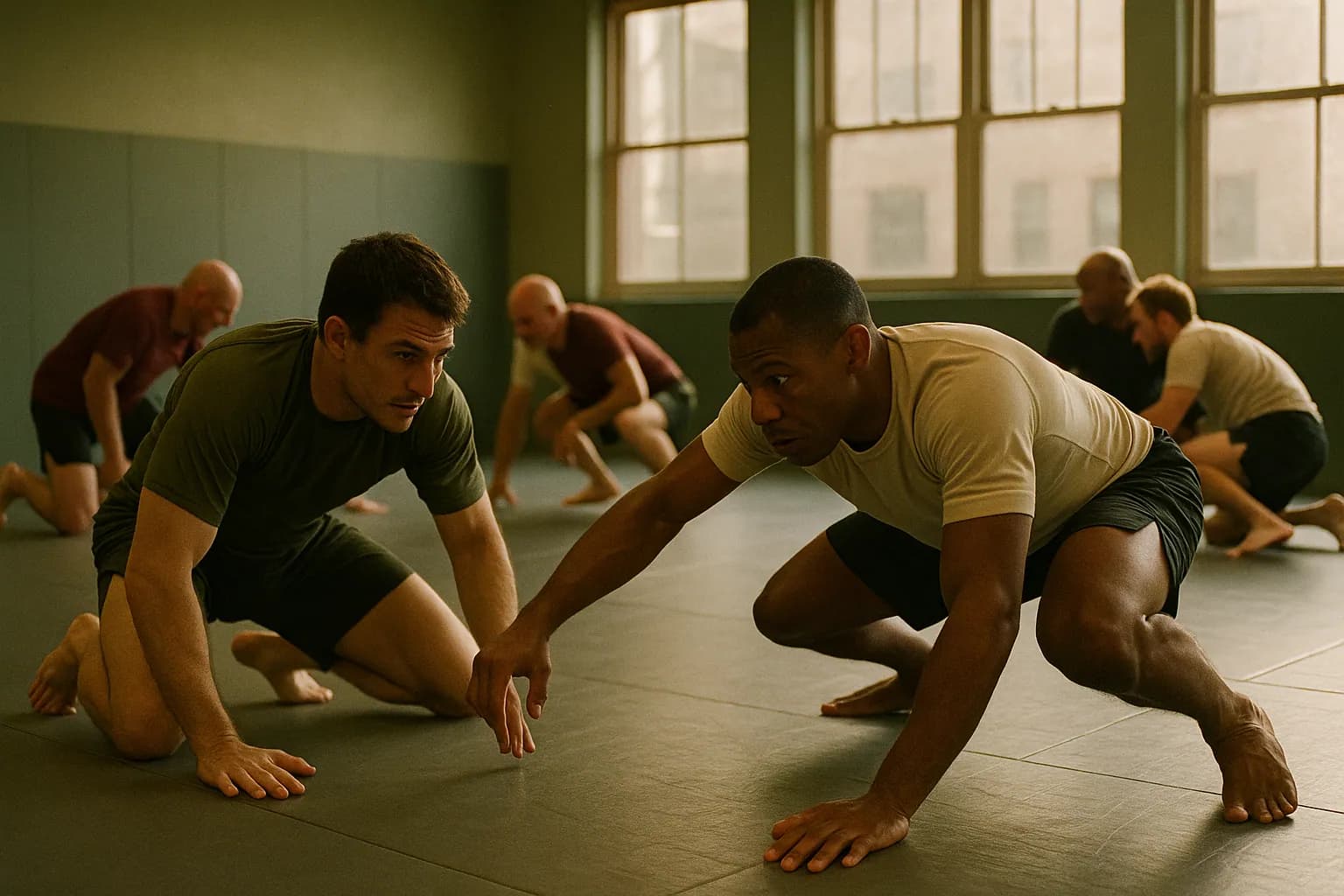
People stay active in a lot of different ways: gym routines, team sports, hiking, classes. Brazilian Jiu-Jitsu is another option, but it doesn't feel like a typical workout. BJJ is a grappling art built on leverage, timing, and problem-solving. You learn how to control and defend against a resisting partner on the ground, without relying on size, strength, or striking.
At KIN, we care about what you train and how you train. This article is about what makes BJJ worth trying, and what you can expect if you step on our mats.
What Makes BJJ Different
Technique matters more than size. BJJ was built so a smaller person can defend against a larger opponent using angles, leverage, and control. That doesn't mean strength is useless, but it isn't the whole game. Good technique, timing, and decision-making matter a lot.
You can train hard and still train safely. BJJ teaches control on the ground. You learn how to escape bad positions, protect yourself, and apply submissions in a controlled way. The tap is a clear way to reset when something is too much. That makes it possible to train with real resistance without treating every round like a fight.
Your mind stays engaged. Rolling is constantly changing. Your partner moves, you adjust, they counter, you solve the next problem. It rewards thinking as much as moving — you're reacting and learning under pressure the whole time, and the workout comes from that engagement as much as from the movement itself.
Progress takes time, and that's part of the value. BJJ rewards patience. Positions that feel impossible in month one start to make sense later. Improvement is uneven: some weeks feel great, others feel stuck. Over time, students build resilience, focus, and confidence that come from showing up and working through difficulty, not from quick wins.
Training at KIN
No one gets good at Jiu-Jitsu alone. You need training partners, feedback, and a room where people take that seriously.
At KIN, we try to build a culture where people help each other improve. That might mean a more experienced student walking a newer student through a position after class, or partners slowing down a round to work on something specific. Some training is competitive. Some is technical. The point isn't just to win rounds in the gym. It's to leave better than you arrived.
Our room includes competitors, parents training for the first time, students coming back after time away, and people here mainly for fitness or stress relief. BJJ doesn't have to look the same for everyone. If you want to read more about how we think about training culture, see Our Philosophy: We Get Better Together.
Who It Is For
BJJ is demanding, but you don't need to arrive "ready." Most people start with no martial arts background. You don't need to be in peak shape before your first class. You build conditioning by training.
If you're curious about kids programs, start with our Tots and Youth guides. If you want to know what the first few visits feel like, read Your First Week at KIN.
Closing
You can get a workout almost anywhere. BJJ offers something else: a practical martial art, a room full of partners who push you to improve, and a long-term skill that keeps teaching you something new. If that sounds like what you're looking for, book a free trial and see how it feels on the mats.